The Tabletop Takes the Abuse
In a commercial restaurant, the tabletop endures hot plates direct from the pass, cleaning chemicals applied 20+ times per day, and physical impact from flatware and dishware. The material choice determines whether the table looks presentable after 6 months or needs refinishing after 6 weeks.
Solid Wood — Beautiful, Repairable, Expensive
Solid hardwood tabletops (oak, ash, walnut, teak) can be sanded and refinished 3–5 times over their lifespan — a capability no other surface material offers. For fine-dining restaurants where table appearance directly impacts the check average, this refinishability justifies the 2–3× cost premium over veneer. Specify a minimum 25mm thickness for tables under 120cm diameter; 30mm for larger. A full bullnose edge is more impact-resistant than a square edge with chamfer.
The finish is more important than the wood species. A two-component acid-catalyzed (AC) lacquer or UV-cured finish provides heat resistance to 85°C and chemical resistance. Single-component lacquers and oils have no place in commercial dining — they degrade within weeks of restaurant use.
Wood Veneer on Engineered Substrate — The Standard Compromise
Veneer tabletops (0.6mm+ real wood veneer on moisture-resistant MDF or plywood core) offer the wood look at 40–60% of solid wood cost. The critical specification: the core must be MR (moisture-resistant) grade, not standard MDF, which swells irreversibly when moisture penetrates edge banding. Edge banding should be minimum 2mm solid wood or matching PVC — anything thinner separates within months.
High-Pressure Laminate (HPL) — The Workhorse
HPL tabletops (Formica, Wilsonart, Abet Laminati) are the standard for casual dining, QSR, and cafeteria applications. 0.7–0.9mm HPL bonded to moisture-resistant particleboard or plywood creates a surface that resists heat, stains, impact, and cleaning chemicals — all at the lowest cost per table. The limitation: HPL cannot be refinished. Once the surface wears through (typically 3–5 years in high-volume use), the entire tabletop must be replaced. Black core HPL hides edge wear better than standard HPL with a brown core.
Stone and Solid Surface — Premium, Permanent
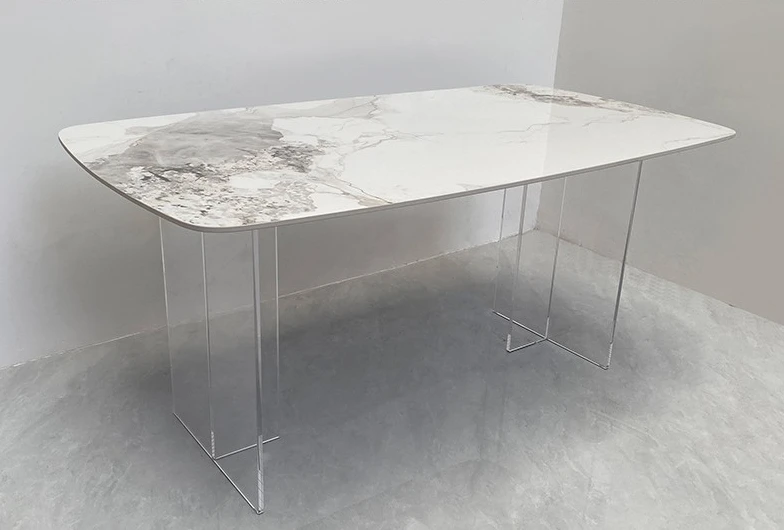
Quartz composite and solid surface (Corian, Hi-Macs) tabletops are effectively permanent — they do not stain, scratch out easily, and can be sanded and refinished on-site. The weight penalty is significant: a 120cm × 80cm quartz tabletop weighs 45–55 kg versus 15–20 kg for HPL on particleboard. This affects shipping costs and requires reinforced table bases.
Browse our commercial dining table catalog with tabletop material options configurable for any F&B format.