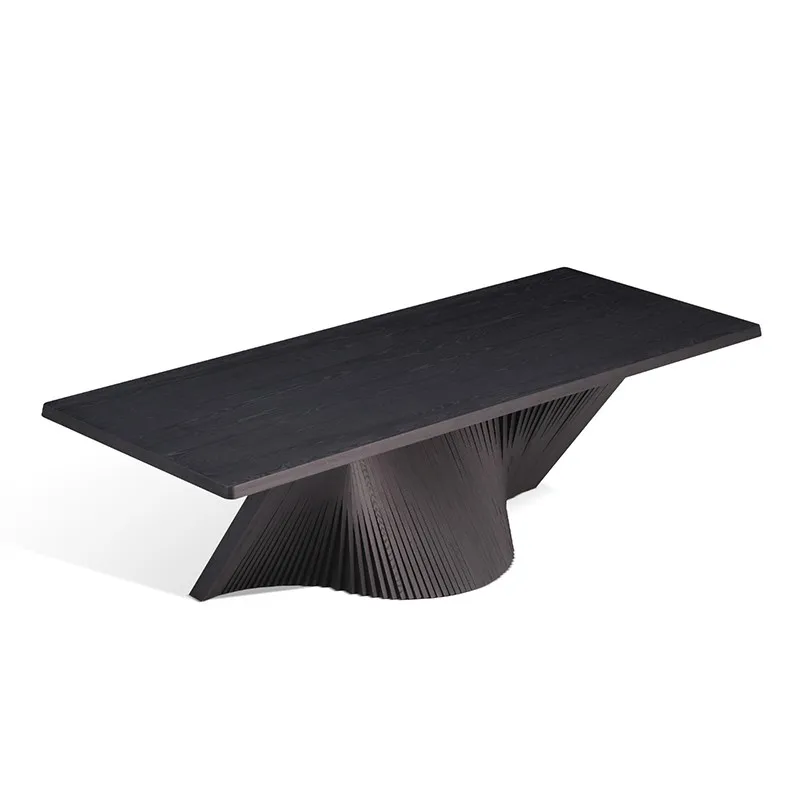
The Edge Is Where Guests and Staff Touch the Table Most
Diners rest their arms on the table edge. Staff wipe the edge hundreds of times per week. A sharp corner on a table can bruise a hip, tear a server’s apron, or catch a sleeve. A poorly sealed edge absorbs moisture and delaminates. Dining table edge profiles and corner finishing may seem like a minor detail, but they determine safety, durability, and how the table ages under commercial use.
Bullnose Edge — The Safest and Most Traditional
A full bullnose or half-bullnose edge is a continuous rounded curve along the table perimeter. It is the most comfortable edge for resting forearms during a long meal and the safest in tight restaurant layouts where guests and staff move close to tables. A bullnose edge also helps laminate and veneer tabletop finishes last longer because the rounded surface wears more evenly than a sharp corner where finish is thin.
On solid wood tables, a bullnose edge can be routed into the solid material. On HPL tables, the bullnose profile is formed during the post-forming process where the laminate wraps over the edge. Both methods should produce a smooth, consistent curve without visible seams or ridges.
Chamfer Edge — Modern, Clean, With a Defined Line
A chamfered edge cuts the top corner at a 45-degree angle, creating a flat angled surface with two defined lines. This profile suits modern and minimalist restaurant interiors because it reads as crisp and architectural. The chamfer width is typically 3—8mm — a narrow chamfer for subtle definition, wider for a stronger design statement. Chamfered edges are slightly less comfortable for arm resting than bullnose, but the difference is negligible for most diners.
Eased Edge — Simple, Cost-Effective, Widely Used
An eased edge is a basic radius on the sharp corner — essentially a very small roundover, typically 1—2mm. It removes the sharpness without creating a visible profile. Eased edges are the standard on HPL tables and are the most cost-effective edge treatment for high-volume casual dining. The limitation: eased edges expose the laminate core line along the perimeter, which can absorb moisture if not properly sealed.
Corner Radius on Rectangular Tables
Square corners on dining tables are the highest-risk detail in a restaurant. At minimum, specify a 20—30mm corner radius on all rectangular tables in public dining areas. Staff corridors, high-traffic zones, and family restaurants with children should use 40—50mm corner radii or fully rounded ends. The cost difference is negligible compared to one injury claim.
Edge Profile Selection by Venue
- Fine dining: bullnose or half-bullnose on solid wood — comfortable for long meals
- Casual and QSR: eased edge on HPL — cost-effective and practical
- Modern and design-led: chamfer edge in matching or contrasting finish
- Family and high-traffic: rounded corners 40mm minimum, bullnose edge
- Verify edge sealing, corner radius, and consistent profiling on pre-production samples
View Baotian dining tables with edge profiles configurable by restaurant format and tabletop material.
Related Furniture Procurement Resources
Use these resources to turn the article topic into a clear product specification, supplier review or project quotation.